
Resources - Blog
France’s E-Invoicing Mandate: What FNFE-MPE’s New Check-Lists Mean for Your ERP
By Ioana Millon (Ploesteanu)
August 06, 2026
Read time:6 MINUTES

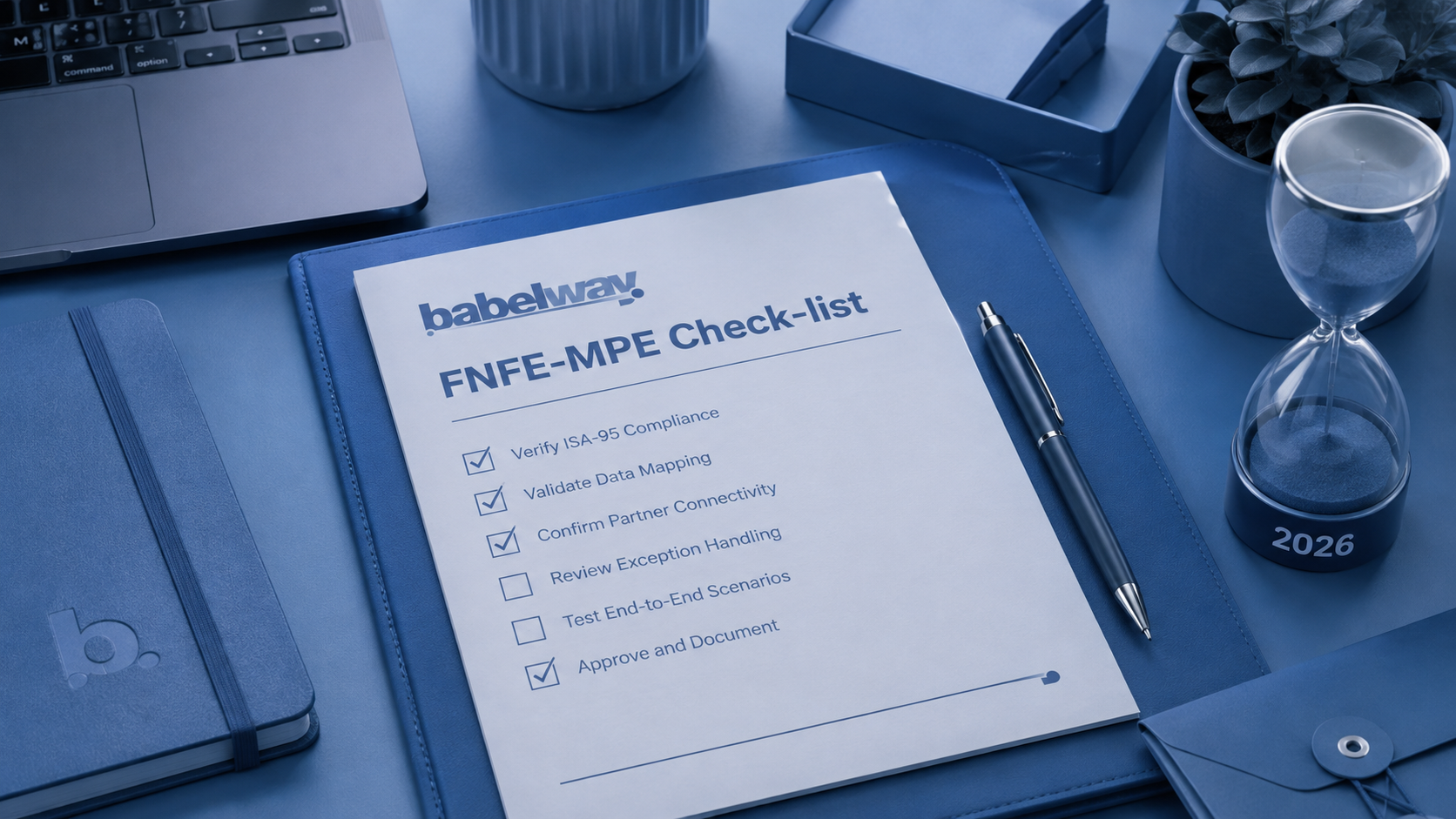
FNFE-MPE just published three go-live check-lists ahead of September 1, 2026. Here’s what they actually require of an ERP-to-PA connection.
With a few weeks left before France’s e-invoicing mandate takes effect on September 1, 2026, FNFE-MPE has published a three-part check-list meant to catch the operational details that tend to get missed before go-live. It’s a companion to the DGFiP’s own Guide pratique de démarrage, and it’s short on purpose. It doesn’t re-explain the mandate. It lists the specific things that tend to break in an ERP-to-PA connection once it’s handling live invoices instead of test data.
It’s worth being precise about what’s actually required here. The mandate itself is technology-neutral: it requires invoices to move through a Plateforme Agréée (PA) in one of three accepted formats, Factur-X, UBL, or CII, along with the right status and e-reporting behavior. It doesn’t specify how a business gets its data to the PA in the first place. In practice, though, that data starts in an ERP, and very few ERPs produce Factur-X, UBL, or CII natively. They export a PDF, an internal XML, an IDoc, whatever made sense when the system was set up, and none of it is what a PA expects to receive.
So while the law doesn’t mandate any particular architecture, something still has to bridge that gap for most businesses, and that’s the layer these check-lists are really testing.
France doesn’t run e-invoicing through one central platform. Each business picks its own PA, and PAs stay in sync through a shared directory, the Annuaire, managed by the PPF.
FNFE-MPE built its check-list around that structure: one part for businesses receiving invoices (Volet A), one for the PAs themselves, including ours, Tradeshift Babelway (Volet B), and one for businesses issuing invoices and handling e-reporting (Volet C).
Volet A: is your ERP actually set up to receive?
This one applies to every VAT-registered business in France, no matter the size. The check-list comes down to four practical points:
- One reception address per SIREN is usually enough. Extra addresses with no real reason behind them just create more places for an invoice to get lost.
- Your PA connection needs to be under contract and correctly listed in the Annuaire.
- Have a plan for duplicate invoices before they land in your finance team’s inbox, not after.
- Use the “Rejected” (Refusée) status only when an invoice is genuinely rejected, not as a catch-all.
None of this touches your ERP’s core logic. It’s about making sure the connection around it is configured correctly and tested against real trading partners, not just against sample data.
Volet B: what your PA should already be doing
Volet B is technically written for PAs, but it doubles as a way to check your own PA’s homework.
At onboarding, does it verify who’s actually signing on your behalf?
Does it keep your Annuaire entries accurate, and can it move you to a new provider without a gap in service if you ever switch?
Does it synchronize with Peppol daily, and does it properly support the socle formats and the AFNOR XP Z12-012 standard, including the CDAR status messages?
If you can’t get a clear answer to those questions from your PA, that’s worth raising before September, not after.
Volet C: can your outbound flows actually produce this?
For large enterprises and ETIs issuing invoices from September 1, and for any SME getting ahead of its 2027 deadline, this is the volet that matters:
- Compliant outbound flows in Factur-X, UBL, or CII
- Correct handling of status returns such as the BT-34 electronic address field
- A process for rejections and disputes
- The e-reporting streams that cover B2C and cross-border activity outside domestic B2B
None of this has to happen inside the ERP itself. It needs a layer that can take whatever the ERP already produces and turn it into what the mandate expects.
How Babelway supports e-invoicing compliance in France
Tradeshift Babelway holds permanent registration (“immatriculation définitive”) as a Plateforme Agréée in France, aligned with the September 2026 mandate and the latest AFNOR and AIFE specifications.
Whatever your ERP already produces, XML, Edifact, IDocs, CSV, JSON, or PDF, Babelway transforms it into the mandated UBL, CII, or Factur-X structure for outbound flows, and converts incoming e-invoices back into whatever your ERP expects, over whichever gateway your systems already use: API, SFTP, AS2, or email.
What choosing Babelway looks like in practice
More than 20 businesses have already chosen Babelway as their Plateforme Agréée, and speed is a common thread among them, and they don’t all come from France.
Take a UK-headquartered toy and games manufacturer with operations in France. Once it settled on Babelway as its PA, getting its ERP connected and going live took 24 days. The company is now compliant well ahead of the September 1 deadline, which means they can stop thinking about it and get back to running the business.
If you are already a Babelway customer
Check your ERP mapping against these three check-lists with your account team, and confirm your reception flows are tested before September.
If you are not yet a Babelway customer
Try Babelway free for 30 days or contact our team to talk through connecting your ERP to a registered French PA before the deadline.
When to consider Tradeshift instead
If France is one piece of a bigger picture, multiple countries, supplier collaboration, AI-driven invoice processing, our sibling platform Tradeshift runs on the same PA registration with full inbound and outbound AP automation across 70 countries.
Also on the Babelway blog
If you are preparing for the September deadline:
👉 France’s e-invoicing mandate: the final stretch before September 2026 |
👉 8 common misconceptions about Plateformes Agréées |
👉 How SMBs can send and receive compliant e-invoices in France.