
Product - Protocol
Peppol
What is Peppol?
Peppol stands for the Pan-European Public Procurement Online and it is an open network that enables businesses and governments to exchange standards-based electronic documents.
In essence, it is an open and free way for businesses to communicate with each other via a framework that requires minimal interaction between both parties. Unlike other B2B or B2G networks, Peppol leverages standards and a unified registry to enable communication to occur without prior testing or setup.
Anyone who becomes a Peppol participant is publishing their information on the network, allowing other companies to send and receive documents with that partner. A company simply needs to publish which document types they will accept and some identifying information about them to be found by other parties. Then, the sending party can send files directly to the framework. All the receiver identifying information is contained in the document.
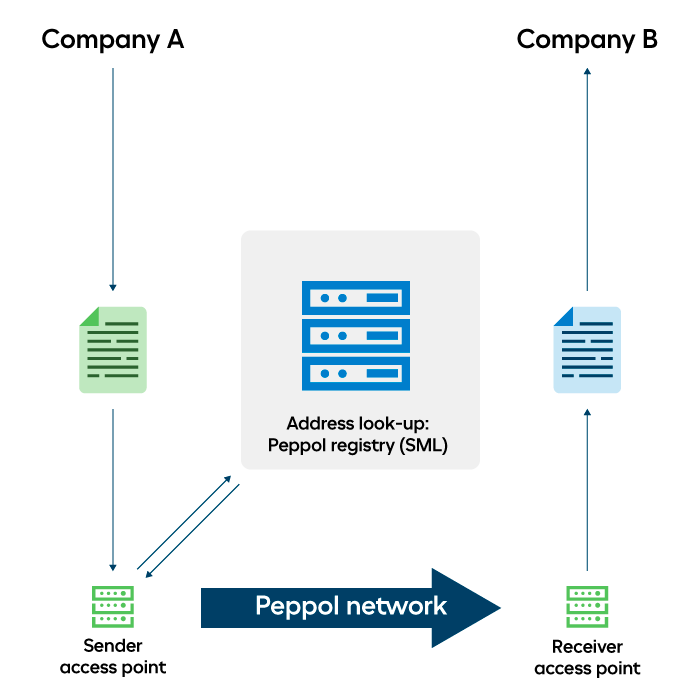
Peppol uses a four-corner model
An access point is the way a participant can send or receive documents via Peppol. Some companies are known as Access Point Providers, and offer services to communicate with Peppol participants. Babelway is an Access Point Provider. The Registry (or SML) includes the shared database of identifying information about each participant and the connection details of their access point.
Getting started with Babelway
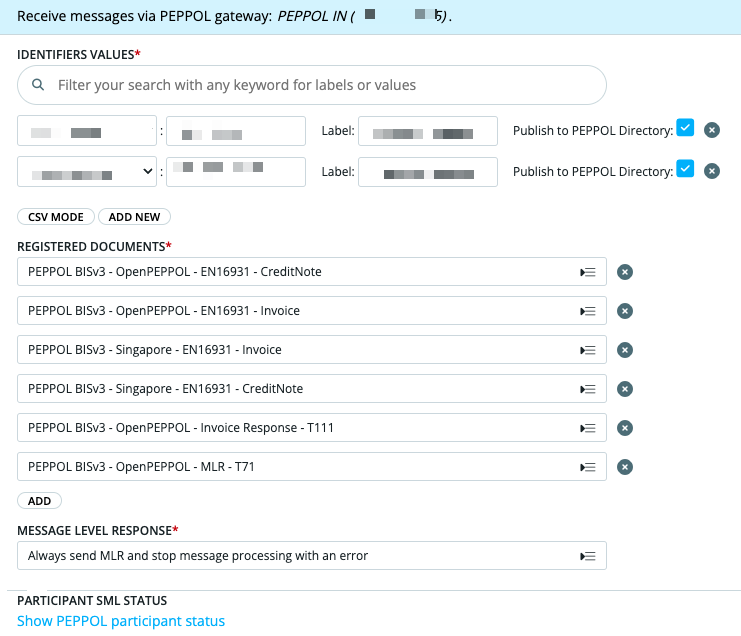
1. Fill in your PEPPOL ID
2. Select document types to support on PEPPOL
3. Deploy and that's it!
The gateway configuration within Babelway is relatively simple. All you have to do is input your identifying values and which document types you accept.
Peppol uses standard documents that participants are allowed to send and receive. There are many options to choose from, but all are based off of UBL standard XML.
In addition to setting up a Peppol gateway, you also have to configure the Message that you will be sending or receiving. This consists of using UBL standard documents and transforming them to/from files that your system deals with.

Why Babelway?

Set up with ease
Deploy your connection in seconds, making it ready for testing immediately.

Transform any format
Use simple drag & drop tools to map your message to any other format for easy import/export in or from your database.

Connect to anyone
Connect your Babelway environment using any EDI or non-EDI communication protocols.

Support
Babelway is not only a great self-service platform but also a team of pros ready to help you succeed.
- Access our support helpdesk anytime and ask your questions. You will be answered as soon as max 60 minutes
- Spot the ‘reuse and save time’ zone on the right of the screen? Import messages and maps from our catalog
- Access online training material through Babelway Academy
Guide
EDI, B2B Integration, and Peppol: A Guide to Easy Document Exchange
The Peppol network leverages EDI standards to facilitate trade to enable secure, standardised, and interoperable electronic communication between businesses across Europe and beyond. In this guide, we’ll focus on the use case of e-invoices, one of the many document types that B2B integration tools, EDI, and Peppol support to offer an easy solution for business-to-business document exchange.

Blog
How Belgian SMBs Can Prepare for the 2026 E-Invoicing Mandate with Babelway
Starting January 1st, 2026, all VAT-registered businesses in Belgium will be required to issue and receive structured electronic invoices for B2B transactions via Peppol.
Paper and PDF invoices, even if sent via email, will no longer be legally accepted. This move is part of Belgium’s commitment to fight VAT fraud, accelerate digital adoption, and align with the EU’s VAT in the Digital Age (ViDA) strategy.
What have our clients said about Peppol in Babelway?


“Babelway has given us the opportunity to take EDI and PEPPOL into our own hands, offering a surprisingly user-friendly interface and flexibility we hadn’t found anywhere else.”
Read success story >

“After we started with Babelway, we didn’t even look at other suppliers on the market for EDI and B2B Integration – we were just too pleased. It’s fast, affordable and reliable, and that’s exactly what we need.”
Read Success Story >
 Capterra
 G2
G2


 GetApp
Book a demo to see how easy it is to work with Peppol
Where Peppol is used: the 2026 mandate landscape
Peppol has moved from an EU procurement initiative to the backbone of mandatory e-invoicing across Europe. Here is where it stands in 2026:
- Belgium — Mandatory B2B e-invoicing since January 2026, using Peppol as the primary interoperability model.
- Germany — B2G invoicing via XRechnung (Peppol-compatible). Mandatory B2B e-invoicing launching in 2025–2027.
- Italy — B2G invoicing via the NSO system uses Peppol. B2B e-invoicing handled through SDI (FatturaPA).
- Netherlands, Denmark, Finland, Norway — Peppol mandated for public procurement.
- EU ViDA (VAT in the Digital Age) — The EU’s digital VAT reform will further expand Peppol’s role across all member states by 2028.
- France — Uses a Plateforme Agréée (PA) model for B2B, compatible with Peppol-based B2G via Chorus Pro. Babelway is a registered PA.
Babelway has been a certified Peppol Access Point Provider since 2014 and supports all current and upcoming Peppol mandate requirements across these markets.
Frequently asked questions about Peppol
What is Peppol?
Peppol (Pan-European Public Procurement Online) is an open network that lets businesses and governments exchange electronic documents using a shared set of standards. It removes the need for bilateral testing or custom integrations between trading partners.
What is a Peppol Access Point Provider?
A Peppol Access Point Provider is a certified gateway company that connects businesses to the Peppol network. Babelway has been a certified Peppol Access Point Provider since 2014. Documents travel through the sender's and receiver's access points via the four-corner model.
Which countries require or use Peppol?
As of 2026, countries that mandate or strongly use Peppol include Belgium (mandatory B2B since January 2026), Germany (B2G via XRechnung), Italy (B2G via NSO), Netherlands, Denmark, Finland, Norway, Singapore, and Australia. The EU ViDA reform is expected to further expand Peppol usage across all EU member states by 2028.
Does Peppol work for both B2B and B2G transactions?
Yes. Peppol was originally built for B2G (business-to-government) procurement but is now used for B2B e-invoicing too. Babelway handles both B2B and B2G Peppol flows, including the specific document types required in each country.
How do I connect my ERP to Peppol via Babelway?
Babelway connects to your ERP via 10+ protocols (FTP, SFTP, AS2, REST API, and more). You configure your Peppol Participant ID and accepted document types, and Babelway handles routing, transformation, and delivery to and from the Peppol network. Setup typically takes minutes, not weeks.
Learn about the other protocols
Amazon MWS
Amazon Marketplace Web Service, an API that gives sellers programmatic access to Amazon Seller Central data such as orders, inventory, and reports.
Chorus Pro
The French government's official platform for receiving electronic invoices from suppliers to public sector entities.
Dropbox
A cloud file storage and sharing service that can be used as a pickup and drop-off point for exchanging documents with trading partners.
REST API Client
A generic connection method for sending and receiving data over HTTP with any system that exposes a REST API.
RosettaNet
A set of standardized XML-based business process and messaging protocols, used mainly in the high-tech and electronics supply chain.
SAP
A connection to SAP ERP systems, typically via IDocs, BAPIs, or RFC calls, for exchanging business documents and data directly with SAP.
SQL
A standardized language for querying and managing data in relational databases, used here to connect directly to a database rather than exchange files.