
Resources - Blog
France’s E-Invoicing Mandate: The Final Stretch Before September 2026
By Ioana Millon (Ploesteanu)
July 22, 2026
Read time:7 MINUTES

What finance and IT teams connecting through a Plateforme Agréée need to know as the pilot phase closes and go-live approaches
With less than two months to go until France’s e-invoicing reform takes effect, most businesses have already worked out the legal timeline. The harder question is a practical one: can your ERP actually produce, send, and receive the right invoice data, in the right format, through your Plateforme Agréée (PA), with the right status and e-reporting information flowing back? On September 1, 2026, the first wave of obligations becomes mandatory: e-invoicing on reception for all companies established in France, and e-invoicing on issuance plus e-reporting for Large companies (“GE”) and Mid-sized companies (“ETI”).
As the compliance window narrows, France’s standardization body AFNOR has published its final technical guidelines, the tax authority has released fresh statistics from the ongoing pilot phase, and long-awaited legislative texts are due before the deadline. This article breaks down what has just been published, what it means, and what it means for the ERP and integration work still ahead of you.
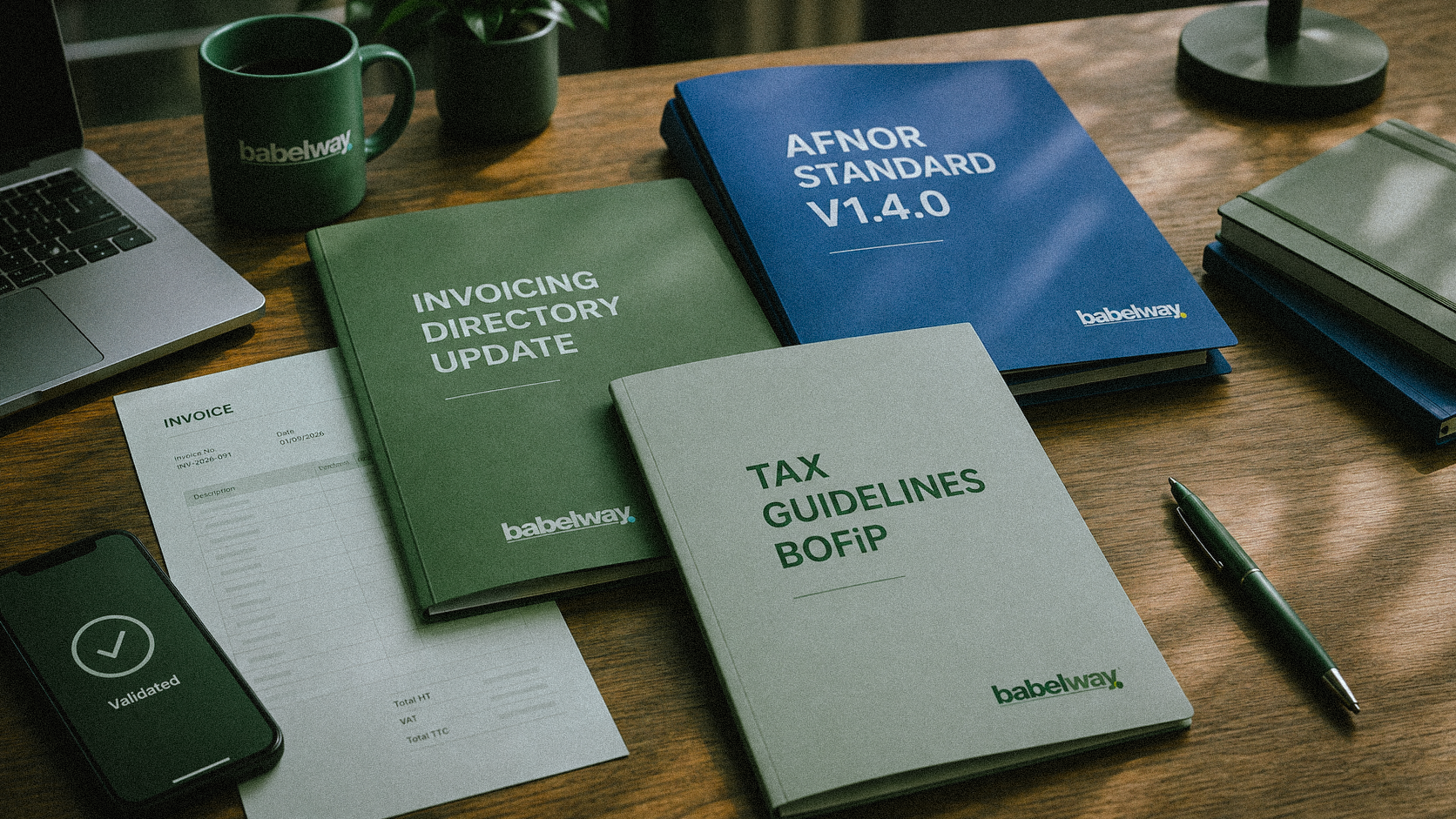
New AFNOR Standards Published (v1.4.0, June 2026)
To guarantee technical alignment before go-live, AFNOR released version 1.4.0 of its e-invoicing standards on June 30, 2026, followed by updated Schematrons on July 3 from the FNFE-MPE (Forum National de la Facture Électronique). For anyone mapping ERP outputs to the French format, these are the changes that matter most:
- XP Z12-012 (Data Structure): adds UBL 2.1 and CII D22 updates, including non-VAT tax codes and private identifiers, bidirectional invoices, line-level Incoterms, and B2G refusal motives.
- XP Z12-013 (APIs): brings general technical corrections and the first official version of the Webhook framework, relevant if your PA connection relies on status callbacks rather than polling.
- XP Z12-014 (Use Cases): adjusts business scenarios such as margin schemes, bidirectional workflows, the “octroi de mer” tax, and additional B2G refusal motives, all of which need to be reflected in how your ERP tags and structures outbound data.
These AFNOR standards must be read alongside the official “External Specifications” published by the AIFE, which describe how Accredited Platforms interact with the reform’s two systems: the PPF (Portail Public de Facturation, used for domestic B2B transactions and e-reporting) and Chorus Pro (used for all transactions involving public entities). A further version of the AFNOR standards is expected around October or November 2026, notably to prepare the move toward UBL 2.5.
PPF Pilot Phase: What the Official Metrics Show
The DGFiP and AIFE, who have been running the PPF pilot phase since February 2026, recently shared new figures on platform activity and ecosystem onboarding. For anyone still testing their ERP-to-PA connection, these numbers are a useful gauge of how much real-world traffic is actually flowing:
- Platform activity: only 25 Registered Platforms, out of close to 150, are currently active in transmitting data through the system.
- Company onboarding: just 3,800 entities have issued e-invoices and 3,400 have received them during the pilot, against a total of more than 11 million entities eventually concerned by the obligation, a participation rate of roughly 0.025%. Only 9 Large companies and 37 Mid-sized companies, the categories facing an immediate issuance obligation in September, have issued invoices through the pilot so far.
- E-invoice volumes: just over 20,000 invoices have been transmitted through the mandatory e-invoicing system, a tenfold increase compared to May 2026 but still a modest figure overall.
- E-reporting volumes: fewer than 100 declarative flows (“Flow 10”) have been received by the PPF, reflecting that most companies and platforms have treated e-reporting as a secondary priority so far.
Tradeshift Babelway is one of the active group: in a recent government status meeting, our PA was listed as having exchanged production data with the PPF, putting us among just 20 Accredited Platforms confirmed to be in production out of roughly 114 currently available. The Chorus Pro environment, used for transactions with the public sector, only joined the national pilot architecture in June 2026.
The E-Invoicing Directory (Annuaire): Progress and Gaps
Populating and maintaining the PPF’s public directory, known as the “Annuaire,” is one of the most critical structural pieces of the French model, since it is what tells your PA where to route an outbound invoice, and how a buyer’s PA should reach you on reception.
- Total registered entities: following a major update on June 10, 2026, 11.2 million legal entities are now registered in the directory, including 1.2 million newly added entities, mainly real estate companies (“SCI”) and specific healthcare professionals.
- Platform appropriation rate: only 1.4 million entities, roughly 12% of the total, have declared at least one Accredited Platform on reception.
- Directory traffic: 51 Registered Platforms are currently active in transmitting directory flows, with around 360,000 directory updates successfully processed since the end of February 2026.
For your integration work, the practical takeaway is this: a notable number of taxable entities established in France, particularly in the liberal healthcare and real estate sectors, are still missing from the directory, and full enrichment is unlikely to be complete by September 1, 2026. Don’t assume a customer or supplier is correctly routable just because they should be in scope, test the actual directory lookup and routing for your key trading partners directly.
Upcoming Tax Guidelines (“BOFiP”) and Legislative Publications
The administrative and legal framework underpinning the mandate is entering its final alignment stage. The French tax authority has announced two forthcoming sets of official guidelines (“BOFiP” – Bulletin Officiel des Finances Publiques):
- E-reporting guidelines: expected before September 1, 2026.
- E-invoicing guidelines: scheduled for publication after that date.
Both texts are expected to go through a public consultation phase in the coming weeks. The tax authority also confirmed that existing rules on mandatory invoice content will remain entirely unchanged, and the long-awaited application decree and ministerial order are scheduled for publication during July 2026. Because these texts set the final legal enforcement parameters of the reform, plan to review and integrate them into your production environment quickly once published.
Confirmed Deadline and a Pragmatic “Soft Landing”
The tax authority has reiterated that the go-live date of September 1, 2026 remains unchanged, with no postponement under consideration. At the same time, a practical guide recently published by the DGFiP, covering 29 key topics, sets three expectations for the first months of the mandate:
- The legal timeline is unchanged: from September 1, 2026, in-scope businesses must be able to receive e-invoices, and those subject to the issuance mandate must send invoices through an Accredited Platform.
- Business continuity takes precedence: invoices exchanged via existing channels, such as PDF, email or paper, remain valid for commercial, accounting and VAT purposes when they relate to a genuine transaction.
- A pragmatic “soft landing” will apply: temporary difficulties will not be sanctioned where companies can show a genuine and documented compliance effort, though the obligation itself remains fully in force.
In short: no postponement, and no formal grace period, but a clear willingness to prioritize guidance over penalties during the transition. That makes now the moment to get your ERP connection tested and working, rather than waiting for the enforcement conversation to start.
What This Means for Your ERP and Integration Work
The pilot phase numbers are a useful reality check: platform onboarding, company participation and directory completeness are all running behind where they would ideally be two months before a hard deadline. For your team, that translates into a short, practical checklist:
- Output formats: confirm your ERP can produce data in the structures the reform actually requires, UBL, CII and Factur-X, not just a PDF or an internal export format. Many ERPs can already generate XML or CSV, but not necessarily in the structure the French mandate expects.
- Connectivity channel: decide how your systems will connect to your PA, whether via API, SFTP, AS2, email, or another gateway, based on what your ERP already supports rather than forcing a rebuild.
- Reception, not just issuance: the obligation to receive e-invoices applies to every business established in France from September 2026, even if your own issuance obligation only starts in 2027. Make sure inbound flows are tested, not only outbound ones.
- Lifecycle status and rejections: decide where invoice statuses, rejections and refusals should land, and who is responsible for acting on them, before they start arriving in production.
- E-reporting data: confirm the data needed for B2C, international B2B, and payment reporting is available and structured correctly, even where it falls outside the domestic B2B e-invoicing flow itself.
How Babelway Supports E-Invoicing Compliance in France
Tradeshift Babelway holds permanent registration (“immatriculation définitive”) as a Plateforme Agréée in France, aligned with the September 2026 mandate and the latest AFNOR and AIFE specifications. Babelway is built for one thing: connecting your existing ERP and financial systems to the French e-invoicing framework, quickly, without asking you to rebuild your systems first.
Whatever format your ERP already produces, XML, EDIFACT, IDoc, CSV, JSON, or PDF, Babelway transforms it into the mandated UBL, CII or Factur-X structure for outbound flows, and does the reverse for reception, converting incoming e-invoices back into whatever your ERP or accounting system expects. Connectivity runs over whichever gateway your systems already use, API, SFTP, AS2, or email, and lifecycle statuses, rejections and refusals are routed back to your ERP or finance workflow automatically.
Babelway is the right fit if you have one or two ERPs, mainly need to send and receive invoices without complex supplier onboarding, and want a focused, fast integration layer rather than a full accounts payable platform. If your French obligations are just one part of a broader picture, multiple countries, supplier collaboration, AI-driven invoice processing, our sibling platform Tradeshift covers the same PA registration alongside full inbound and outbound AP automation across 70 countries. You can read more about when each platform is the right choice in our earlier article on choosing between Babelway and Tradeshift for France.
If you are already a Babelway customer
Reach out to your account team to confirm your ERP mapping is aligned with the June 2026 AFNOR v1.4.0 update and to test your reception flows ahead of September.
If you are not yet a Babelway customer
You can try Babelway free for 30 days or contact our team to discuss connecting your ERP to a registered French PA before the September 2026 deadline.