
Resources - Blog
How to Choose Your EDI & B2B Integration Tool Based on Your Business Objective
By Ioana Millon (Ploesteanu)
May 19, 2026
Read time:7 MINUTES

Tool long; Didn’t read (TL;DR)
- The best EDI and B2B integration tool isn’t the one with the longest feature list. It’s the one aligned to the business objective driving your project.
- Six objectives cover most buyer scenarios in 2026: faster partner onboarding, lower total cost of ownership, e-invoicing compliance, retail and supply-chain scale, ERP and API modernization, and reclaiming control from a managed service.
- For each objective, the right tool is the one that removes friction from that outcome, not the one with the most modules.
- Babelway is built to flex across all six objectives with self-service mapping, transparent pricing, and broad format and protocol coverage.
- Related read: Best EDI and B2B Integration Tools in 2026: A Practical Comparison Guide for Modern Supply Chains.
Why Your Business Objective Should Drive the Tool Choice
Most EDI shortlists start with the wrong question. Teams ask, “Which platform is the most powerful?” when they should be asking, “Which platform is the right shape for the outcome we are being measured on?”
A supplier being onboarded by a retail chain has a very different problem than a manufacturer migrating off a legacy on-premise stack, or a finance team rushing to comply with France’s Plateforme Agréée e-invoicing reform. Each of those problems rewards a different kind of EDI tool. Choosing without naming the objective first is how organizations end up with platforms that look impressive in a demo and frustrate the team eighteen months later.
This guide walks you through the six business objectives that drive most EDI and B2B integration purchases in 2026, and shows you how to translate each one into a tool selection that actually fits.
👉 If you’re still mapping the landscape of vendors, start with the companion piece: Best EDI and B2B Integration Tools in 2026.
Step 1: Name Your Primary Business Objective
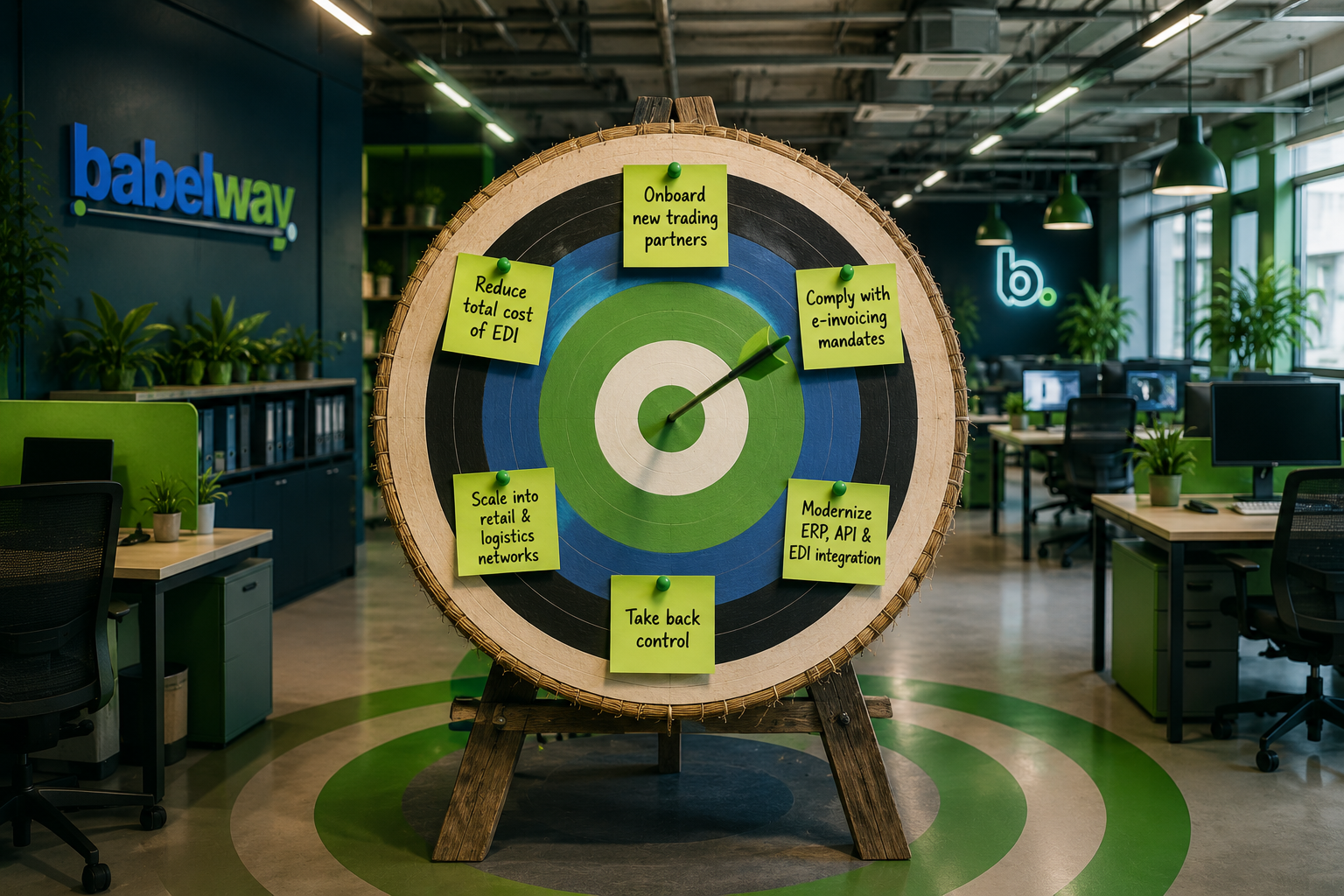
Before you read a single G2 review, write down the single sentence your leadership team would use to describe success twelve months from now. It usually falls into one of these six categories:
1. Onboard new trading partners faster.
Your sales team is closing deals your EDI team can’t keep up with. Backlogs are growing. Every new partner takes weeks of mapping work and pulls developers off the roadmap.
2. Reduce the total cost of EDI ownership.
Your current platform is expensive, your renewal is approaching, and finance has flagged EDI spend as an outlier. You need a transparent cost model and fewer professional-services dependencies.
3. Comply with a new e-invoicing or regulatory mandate.
France 2026 to 2027, Belgium 2026, Spain’s Verifactu, the broader Peppol rollout. Each has hard deadlines and operational risk if you miss them.
4. Scale into a retail, logistics, or supply-chain network.
You are onboarding into Walmart, Amazon, Carrefour for example, or a 3PL ecosystem and need to handle volume, ASNs, and strict SLA windows.
5. Modernize ERP, API, and EDI integration as one stack.
Your IT strategy is converging integration onto a single platform. You want EDI to live alongside REST APIs, SAP IDocs, and event-driven flows without being a separate team’s problem.
6. Take back control from a fully-managed EDI provider.
You are tired of waiting on tickets for every map change. You want to own the platform without owning the infrastructure. See Taking Ownership of EDI and B2B Integrations with Babelway.
Pick the one objective that matters most. The others can be secondary, but a tool optimized for everything tends to be optimized for nothing.
Step 2: Match Your Objective to the Right Capabilities
Each objective rewards a different short list of capabilities. Use this as a starting screen before you book demos.
🎯 If your objective is faster partner onboarding, prioritize self-service mapping, a graphical interface, reusable templates, and a platform that doesn’t require a developer for every new channel. The self-service EDI platform model consistently outperforms fully-managed services on velocity, because nothing waits in a vendor’s queue.
🎯 If your objective is lowering total cost of ownership, look for transparent published pricing, predictable per-channel or per-volume models, and minimal professional-services dependencies. Hidden fees usually hide in onboarding, change requests, and partner additions.
🎯 If your objective is regulatory compliance, prioritize platforms that are formally certified (in France, a registered Plateforme Agréée), connected to Peppol, and aware of country-specific reforms. Compliance is not a feature you bolt on later. It has to be in the platform’s DNA.
🎯 If your objective is retail and supply-chain scale, prioritize X12 and EDIFACT depth, AS2, VAN connectivity, robust ASN handling, and real-time monitoring. Your retailer’s compliance team will tell you what they need; your platform just has to deliver it without drama.
🎯 If your objective is ERP and API modernization, prioritize broad protocol coverage including REST, modern JSON support (see Babelway’s JSON V2 release), and an architecture that treats EDI and APIs as peers.
🎯 If your objective is reclaiming control, prioritize platforms with open self-service tooling, in-product editing, transparent logs, and a learning path so your team can become self-sufficient, like the free Babelway Academy.
Step 3: Pressure-Test the Shortlist Against Reality
Once you have two or three platforms aligned with your objective, run them against three pressure tests before signing.
The 90-day test. What does success look like 90 days from go-live? Ask each vendor to walk you through how a real partner you name would be onboarded, who does the work, and how long it takes. Specificity exposes vaporware.
The change test. EDI projects don’t end at go-live. They live forever, because partners change constantly. Ask each vendor what happens when a partner moves from EDIFACT to UBL, or when your ERP team adds a new field to a purchase order. The answer is usually the difference between a self-service edit and a six-week professional-services engagement. The EDI Integration Tune-Up Checklist is a useful frame here.
The exit test. Can you leave? Ask how data, maps, and channel configurations are exported. Tools that make migration easy are also tools that have earned your trust in the first place. A vendor that gates your data is a vendor that will eventually leverage that gate at renewal.
👉 Check out what Babelway users say about Babelway’s EDI and B2B integration capabilities on G2.
See How Babelway Fits Your Business Objective: Book a Demo
Reading a comparison only gets you so far. The fastest way to test fit is to put your own use case on the platform. Book a demo with a B2B integration specialist and walk through a real partner you need to onboard, a real document you need to translate, or a real compliance deadline you need to hit. You’ll see, in your own terms, whether Babelway is the right shape for the outcome you’re being measured on.
Book a personalized Babelway demo →
Try Babelway Free for 30 Days and Test Your Own Objective
If you prefer to test the platform before you talk to anyone, Babelway offers a no-strings 30-day trial. Build a channel, map a document, send a transaction, and see how the platform handles the objective driving your project, whether that’s onboarding velocity, regulatory compliance, or reclaiming control from a legacy vendor.
Start your 30-day Babelway trial →
Why Babelway Aligns Across Every Business Objective
Every EDI platform will move a message. What separates Babelway is that the same product shape (cloud-native, self-service, broad format and protocol coverage, transparent pricing) happens to be the right shape for almost every objective on the list above.
- For onboarding velocity, Babelway customers regularly go live with new partners in days. For lower TCO, pricing is published and predictable.
- For compliance, Babelway is a registered Plateforme Agréée in France and Peppol-connected across Europe. See the Babelway Peppol guide.
- For retail and supply-chain scale, the platform handles X12, EDIFACT, AS2, and SFTP at volume. See the Martens Brewery case study.
- For ERP and API modernization, JSON V2 and a wide protocol library keep EDI and APIs on equal footing.
- For reclaiming control, the entire platform is built around the principle that your team should own its integrations, confirmed by independent users on G2.
A tool that fits your objective is a tool that gets out of your way. That’s the point.
FAQs
How do I know which business objective should drive my EDI tool selection?
Ask what your leadership team will measure twelve months after go-live. The metric they care about, whether onboarding lead time, EDI spend, compliance posture, or partner satisfaction, is your objective.
If multiple objectives compete, rank them. Most platforms can serve two well; very few serve four.
Is there a single EDI tool that fits every business objective?
No platform is best at everything. The closest fit across multiple objectives is usually a cloud-native, self-service specialist platform like Babelway, because the same architectural choices help with onboarding speed, cost control, and team autonomy.
For a side-by-side view of how the major platforms compare, see Best EDI and B2B Integration Tools in 2026.
How long should EDI tool selection take?
A realistic timeline is four to eight weeks: two weeks to define the objective and shortlist, two to four weeks of demos and proofs-of-value, and one to two weeks for procurement.
Shorter timelines tend to skip the “match objective to capabilities” step, which is where most regret comes from later.
What’s the difference between EDI software and an iPaaS for these objectives?
An iPaaS is general-purpose. It can do EDI, but EDI is one workload among many.
A specialist EDI platform like Babelway is purpose-built for trading-partner integration, which makes it faster on onboarding-driven and compliance-driven objectives.
For a broader definition, see Babelway’s guide to B2B EDI software.
Can Babelway support a phased migration from my current EDI provider?
Yes. Many customers run phased migrations, starting with new partners on Babelway and incrementally moving existing channels off legacy platforms like IBM Sterling, OpenText, or SPS Commerce.
The objective-first approach works especially well here, because the migration itself becomes the objective and the rollout plan flows from it.
Where can I learn more about Babelway’s capabilities before I book a demo?
Explore the Product Tour, browse the free Babelway Academy, or read how customers use Babelway in real operations in How Using the Right EDI Tool Frees Up Time for Strategic Work.