
Resources - Blog
Best EDI and B2B Integration Tools in 2026: A Practical Comparison Guide for Modern Supply Chains
By Ioana Millon (Ploesteanu)
May 12, 2026
Read time:7 MINUTES

TL;DR
- The EDI and B2B integration market in 2026 splits into three categories: enterprise integration suites, general-purpose iPaaS platforms, and specialized B2B integration tools.
- Babelway leads for organizations that want enterprise-grade EDI without the enterprise-grade complexity, cost, or implementation timeline.
- Six tools evaluated: Babelway, IBM Sterling B2B Integrator, Cleo Integration Cloud, SPS Commerce, Boomi, and MuleSoft Anypoint.
- Each scored on partner onboarding velocity, format and protocol coverage, monitoring and visibility, and total cost of ownership.
- Related: How Using the Right EDI Tool Frees Up Time for Strategic Work
The Evaluation Challenge
Someone on the leadership team just asked you to build a shortlist. “Which EDI platform should we be looking at?” The question sounds simple. The answer is not.
Most EDI shortlists start from the wrong direction. They start with the vendor everyone has heard of, the platform IT already pays for, or the tool a consultant recommended last year. They rarely start with the work that actually needs doing: onboarding a new trading partner before a customer escalates, swapping EDIFACT for X12 mid-project, or proving to finance why error rates spiked last month.
That gap is what this guide closes: the space between knowing what your supply chain needs and getting a clean shortlist of tools that can deliver it. Below, we evaluate six EDI and B2B integration platforms against the criteria that matter most for buyer committees in 2026: partner onboarding velocity, breadth of formats and protocols, visibility and monitoring, and the real total cost of ownership.
👉 For a deeper look at what good EDI infrastructure should look like before you start evaluating tools, see the EDI Integration Tune-Up Checklist.
What Is EDI and B2B Integration Software?
EDI and B2B integration software is the connective tissue between you and your trading partners. It translates documents (purchase orders, ASNs, invoices, shipment statuses) between the format your ERP speaks and whatever format each partner requires. It routes those documents over the right protocol (AS2, SFTP, Peppol, VAN, REST API), and it gives you visibility into every transaction. For a refresher on the most common document type in EDI, see What is EDI X12 850 and how to use it.
Today, the market falls into three broad categories:
Enterprise integration suites are full-stack platforms like IBM Sterling or OpenText Trading Grid. They are built for the largest organizations: powerful, deep, and almost always expensive and slow to implement.
General-purpose iPaaS platforms include Boomi, MuleSoft, and Workato. These integrate anything to anything, but their EDI capabilities are typically a module bolted onto a general integration engine.
Specialized B2B integration platforms include tools like Babelway, Cleo, and SPS Commerce. They are built specifically for EDI and trading-partner integration, with the depth of an enterprise suite and the agility of a cloud product.
Knowing which category fits your operation narrows the shortlist quickly.
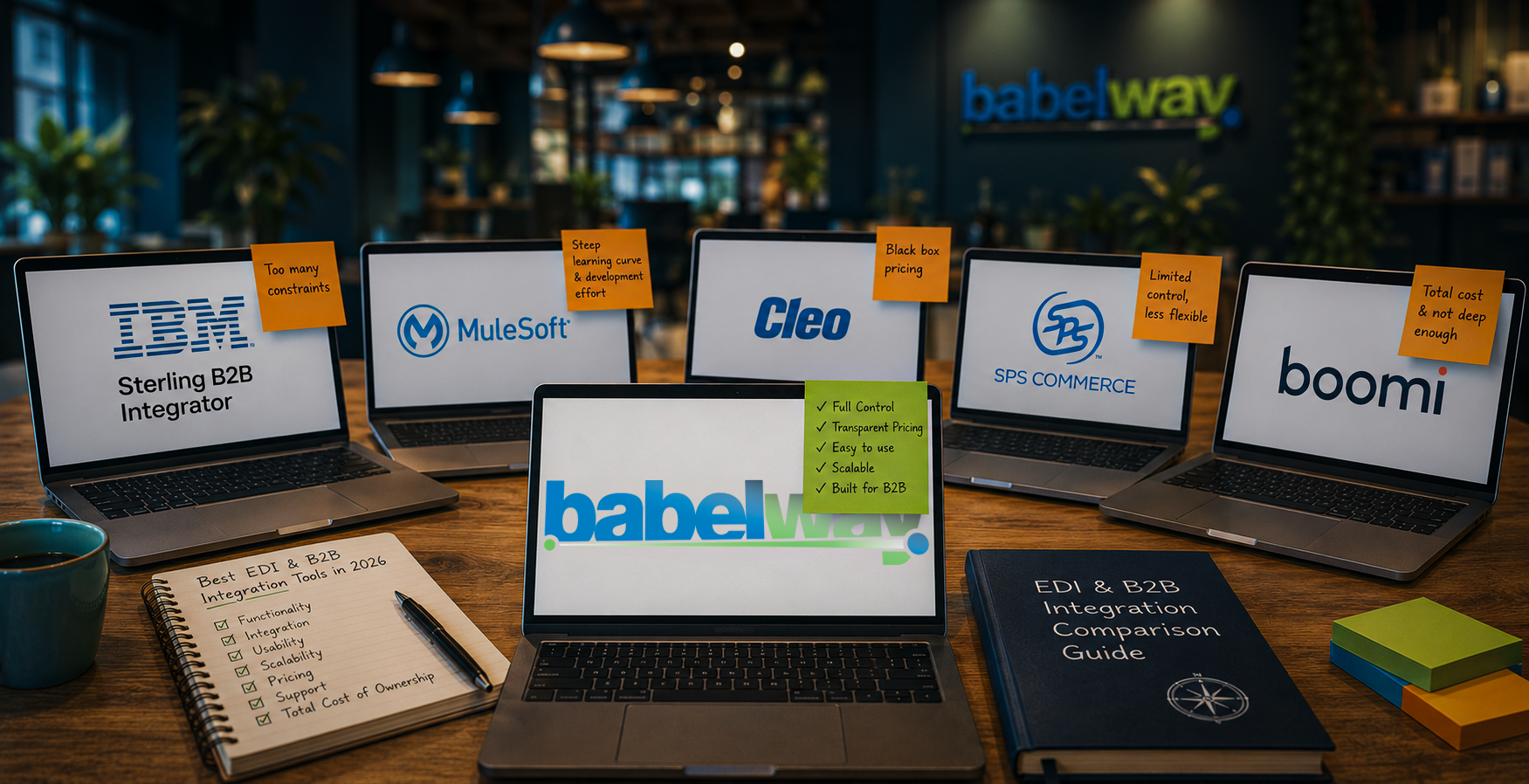
The 6 Best EDI and B2B Integration Tools in 2026
1. Babelway
Quick overview
Babelway is a cloud-based EDI and B2B integration platform built for organizations that want enterprise-grade trading-partner connectivity without enterprise-grade overhead. The platform supports virtually every EDI format on the market, including X12, EDIFACT, UBL, IDocs, XML, JSON, PDF, and flat files. It also supports every major protocol, including AS2, SFTP, Peppol, and REST. Mapping is graphical, drag-and-drop, and self-service. Most customers onboard new trading partners in days, not months, and run their entire EDI estate without a developer team. Babelway is a Tradeshift company and a registered Plateforme Agréée (PA) for France’s 2026 to 2027 e-invoicing reform.
Best for: Mid-market and enterprise organizations that want full control of their EDI and B2B integrations, fast partner onboarding, and a transparent, predictable cost model.
Pros
- Self-service mapping and onboarding: business and integration teams can build, test, and deploy channels without consulting engagements.
- Broad practical format and protocol coverage in a single platform, including a recent JSON V2 release that simplifies API and ERP integrations.
- Cloud-native with real-time monitoring and full transaction visibility out of the box.
- 30-day free trial available, plus a dedicated Babelway Academy and Help Center for self-paced training.
- Compliance-ready for e-invoicing mandates in France, Belgium, Spain, and the broader Peppol network.
Cons
- Not the right fit for organizations that want a fully outsourced, vendor-managed EDI service.
- Functionality is broad, so getting the most out of advanced features rewards an investment in the Babelway Academy.
Pricing: Transparent published pricing plans, plus a 30-day free trial.
2. IBM Sterling B2B Integrator
Quick overview
IBM Sterling B2B Integrator is one of the oldest and most established EDI platforms in the market, used by some of the largest retailers, manufacturers, and logistics providers in the world. It supports virtually every standard you can think of and can be deployed on-premise, in IBM Cloud, or in hybrid mode.
Best for: Very large enterprises with dedicated internal EDI teams and complex on-premise or hybrid landscape requirements.
Pros
- Industry-standard reputation and deep coverage of EDI standards.
- On-premise deployment available for organizations with regulatory constraints.
- Extensive partner and systems-integrator ecosystem.
Cons
- Implementation projects often run six to twelve months.
- Heavy infrastructure footprint and significant licensing cost.
- Mapping and onboarding typically require trained IBM specialists.
Pricing: Contact sales.
3. Cleo Integration Cloud
Quick overview
Cleo Integration Cloud is a B2B integration platform with a strong focus on ecosystem integration for supply-chain-intensive industries. The platform combines EDI, API, and non-EDI integration in one product.
Best for: Logistics, 3PL, and supply-chain-heavy companies looking to consolidate EDI and API integration in a single tool.
Pros
- Strong handling of high-volume EDI plus modern API integrations.
- Good visibility tools for 3PL and supply-chain use cases.
- Flexible deployment options (cloud, hybrid, managed).
Cons
- Self-service capability is more limited than cloud-native alternatives; complex maps often need professional services.
- Pricing is less transparent and tends to scale aggressively with volume.
Pricing: Contact sales.
4. SPS Commerce
Quick overview
SPS Commerce is the dominant managed-EDI service in North American retail, with one of the largest pre-built retailer networks in the world. The Fulfillment product is essentially fully-managed EDI: SPS handles onboarding, mapping, and ongoing changes.
Best for: Suppliers selling into large North American retailers who want EDI handled entirely as a service.
Pros
- Vast pre-built retailer network, with most large North American retailers already connected.
- Fully managed model with minimal internal IT effort.
- Strong retail-specific support and onboarding playbooks.
Cons
- Limited control: customers can’t typically modify maps themselves.
- Less flexible outside core retail use cases, with limited European EDI and e-invoicing coverage.
- Pricing can climb quickly with transaction volume and partner count.
Pricing: Contact sales.
5. Boomi
Quick overview
Boomi is a mature iPaaS that has expanded into B2B and EDI over the years. It’s a strong general-purpose integration platform with a unified design experience across application integration, APIs, and EDI.
Best for: Organizations that want a single iPaaS for all integration types (apps, APIs, data, and EDI) and accept that EDI is one workload among many.
Pros
- Unified platform for iPaaS, API management, and EDI.
- Large library of pre-built connectors for SaaS applications.
- Strong developer ecosystem and community.
Cons
- EDI capability is less deep and less self-service than EDI-specialist platforms.
- Trading-partner onboarding workflows aren’t purpose-built for EDI volume.
- Total cost can rise quickly as you add modules.
Pricing: Subscription-based, contact sales.
6. MuleSoft Anypoint Platform
Quick overview
MuleSoft Anypoint is the integration platform within Salesforce, widely adopted for API-led integration in enterprise IT estates. It supports EDI through dedicated modules and connectors.
Best for: Salesforce-centric enterprises with a strong API-led integration strategy and an existing MuleSoft footprint.
Pros
- Best-in-class for API-led, microservices-style integration.
- Strong governance and reusable assets at enterprise scale.
- Deep Salesforce ecosystem alignment.
Cons
- EDI is not the product’s primary design center; specialist platforms are usually faster and cheaper for pure EDI work.
- Steep learning curve and high licensing cost.
- Onboarding non-technical EDI partners typically requires developer effort.
Pricing: Subscription-based, contact sales.
Summary Comparison Table
| Tool | Best For | Key Differentiator | Deployment Speed |
|---|---|---|---|
| Babelway | Mid-market & enterprise wanting self-service EDI | Cloud-native platform, drag-and-drop mapping, broad protocol & format coverage, transparent pricing | Days to weeks |
| IBM Sterling B2B Integrator | Very large enterprises with dedicated EDI teams | Deepest legacy EDI footprint, on-premise option | Months |
| Cleo Integration Cloud | Logistics and supply-chain-heavy companies | High-volume EDI plus API integration in one product | Weeks to months |
| SPS Commerce | Suppliers to North American retail | Pre-built retailer network, fully managed model | Weeks (managed) |
| Boomi | Companies wanting a single iPaaS for everything | Unified iPaaS across applications, APIs, and EDI | Weeks to months |
| MuleSoft Anypoint | Salesforce-centric, API-led enterprises | API-led integration at enterprise scale | Months |
Why Babelway Leads for Modern B2B Integration
Every tool above will move an EDI message. What separates them is how much friction lives between you and that outcome. With enterprise suites, the friction is implementation timelines and specialist dependencies. With general-purpose iPaaS tools, the friction is that EDI is a feature, not a focus. With managed services, the friction is your loss of control.
Babelway was built specifically to remove those frictions. The platform is cloud-native, drag-and-drop, and explicitly designed so that business and integration teams can take ownership of their EDI and B2B integrations without depending on a vendor or a systems integrator for every change. New trading partners typically go live in days, channels are reconfigured in hours, and the entire estate is visible in one console.
That self-service depth is what customers consistently cite as the difference. As featured in A Self-Service EDI Platform Is the Key to Success and the Martens Brewery case study, the value isn’t the EDI itself, because every platform delivers messages eventually. The value is the velocity, control, and visibility you get along the way.
Check out what Babelway users say about Babelway’s EDI and B2B integration capabilities on G2.
See Babelway in Action: Book a Personalized Demo
The fastest way to test any EDI platform’s fit is to see your own use case run on it. Bring a real onboarding scenario, a real partner, or a real document, and watch how it would behave inside Babelway. The demo is run by a B2B integration specialist, not a generic sales rep, and is tailored to the way your team actually works.
Book a personalized Babelway demo →
Try Babelway Free for 30 Days
If you’d rather get hands-on first, Babelway offers a no-strings 30-day trial. Build a channel, map a document, send a test transaction, and decide for yourself whether the platform fits.
Start your 30-day Babelway trial →
FAQs
What is EDI and why does it still matter in 2026?
- EDI (Electronic Data Interchange) is the structured electronic exchange of business documents like purchase orders and invoices between trading partners.
- Despite the rise of APIs, EDI still underpins the majority of global supply-chain transactions.
- Modern EDI platforms now combine traditional EDI standards with APIs, e-invoicing networks like Peppol, and ERP integration.
- See: What is EDI X12 850 and how to use it and the EDI X12 Transaction Codes hub.
What’s the difference between EDI software and an iPaaS?
- An iPaaS is a general-purpose integration platform for any application or data integration use case.
- Dedicated EDI/B2B integration software focuses on trading-partner connectivity, EDI standards, and supply-chain protocols.
- Specialist platforms like Babelway typically deliver faster partner onboarding and deeper EDI features than iPaaS modules.
How long does it take to onboard a new trading partner with Babelway?
- Most Babelway customers onboard a standard trading partner in days, not months.
- Complex partners with custom mapping requirements can still typically go live within two to four weeks.
- Self-service mapping means many internal teams onboard partners themselves without vendor intervention.
Is Babelway better than IBM Sterling B2B Integrator?
- IBM Sterling is best suited to very large enterprises with dedicated EDI teams and on-premise constraints.
- Babelway typically delivers faster time-to-value, lower total cost of ownership, and a self-service model that doesn’t require specialist consultants.
- For mid-market and most enterprise organizations, Babelway is often the better fit.
Does Babelway support e-invoicing and Peppol?
- Yes. Babelway connects natively to the Peppol network and is a registered Plateforme Agréée (PA) in France.
- See: Easily connect to the Peppol network with Babelway and Babelway earns PDP registration for seamless e-invoicing.
Can I migrate from my current EDI provider to Babelway?
- Yes. Babelway is built to coexist with and migrate from legacy EDI infrastructure.
- Many customers run a phased migration, starting with new trading partners and incrementally moving existing channels.
- The Babelway team and partner network support migrations from IBM Sterling, OpenText, SPS Commerce, and other platforms.
What does Babelway cost?
- Babelway publishes transparent pricing plans, which is unusual in the EDI market.
- A 30-day free trial is available with no commitment, and a personalized demo is available on request.