
Product - Format
CSV
What is a CSV file?
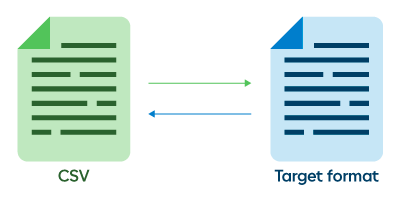
CSV stands for Comma Separated Value. This file format is frequently used for importing or exporting data from a system. It typically contains one line of ‘headers’ that defines each value in subsequent lines. The information below the headers contains the actual data for the document.
Example CSV document
Each value corresponds to the first header row, separated by commas. CSVs can also use characters other than commas to separate each value. For example, it’s common to see ‘|’ used as a separator. These subtle differences in format don’t change the structure of file and are dependent on the system creating the file.
CSV is a very common file format because it can be flexibly defined. A system can simply choose its header values and communicate the values for those headers. For this reason, you are almost guaranteed to encounter a CSV file format when dealing with data integration.
Getting started with Babelway
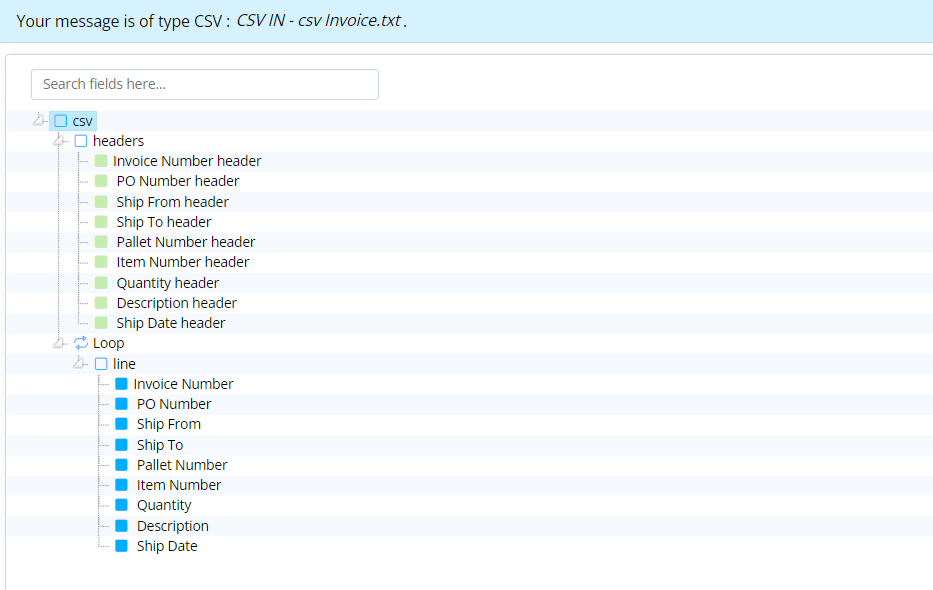
1. Select CSV as message type
2. Upload a sample file
3. Babelway will do the rest
Babelway uses the header row to identify each value. Babelway can map each field to another file format and apply additional data changes to each value if necessary. It’s very easy to control the data, regardless of the incoming CSV’s structure.
Why Babelway?

Set up with ease
Deploy your connection in seconds, making it ready for testing immediately.

Transform any format
Use simple drag & drop tools to map your message to any other format for easy import/export in or from your database.

Connect to anyone
Connect your Babelway environment using any EDI or non-EDI communication protocols.

Support
Babelway is not only a great self-service platform but also a team of pros ready to help you succeed.
- Access our support helpdesk anytime and ask your questions. You will be answered as soon as max 60 minutes
- Spot the ‘reuse and save time’ zone on the right of the screen? Import messages and maps from our catalog
- Access online training material through Babelway Academy
What have our clients said about X12 in Babelway?


“Babelway helps us innovate in B2B collaboration.”
Read case study >

“Their product and their experts ensure that we’ll have an innovative B2B integration solution, not just right now, but in the years to come.”
g2.com
GetApp
Try our free 30 day trial to see how easy it is work with X12
Learn about the other formats
IDocs
SAP's standard data structure (Intermediate Document) for exchanging business documents between SAP systems and external applications.
CSV
A plain-text format that stores tabular data as comma-separated values, commonly used for simple data exports and imports.
Excel
A spreadsheet file format (.xls/.xlsx) often used to manually structure and exchange business data such as orders, invoices, and inventory.
JSON
A lightweight, human-readable data format built on key-value pairs, widely used for exchanging data between modern web applications and APIs.
Tradacoms
A UK-specific EDI standard developed for the retail and grocery sector, commonly used to exchange orders and invoices with British trading partners.