
Resources - Blog
France’s E-Invoicing Mandate, One Month In: What SMBs Should Do Before 2027
By Ioana Millon (Ploesteanu)
October 14, 2026

France’s e-invoicing mandate went live on September 1. Last Thursday, a little over a month in, we sat down with Thibault Samson, co-founder of The Invoicing Hub, together with Michel Colin, VP of the Babelway Business Line, and Diego Mersch, Senior Inside Account Executive at Babelway, to look at what the first weeks actually showed and what they mean for the SMBs whose turn comes next.
If you missed the session, the full webinar is now available on demand. Here are the highlights.
Where the mandate stands, one month in
Two dates, and they’re already getting confused
Since September 1, 2026, every business in France has had to be able to receive e-invoices. Large and mid-size companies (GE/ETI) also have to issue them and file e-reporting. SMBs and micro-enterprises follow on September 1, 2027, when the issuing and e-reporting obligations apply to them too.
Thibault pointed out that the two dates are already being mixed up in practice. Some SMBs assumed something was broken when no e-invoices arrived in September, when in fact most of their suppliers are SMBs themselves and aren’t required to issue until 2027.
What the first numbers say
According to figures the DGFiP shared on October 1, 149 platforms are now definitively accredited, with 14 more still in the accreditation process and not yet permitted to exchange invoices. Around 4 million legal entities are registered in the central directory (the annuaire), and more than 12 million e-invoices worth €37 billion went through the system between September 1 and 27.
The figure that stood out most came from the first week: the daily rejection rate climbed from 7% to 32%, according to launch data published by comparatif-facture-electronique.fr. Registration mostly worked. Format compliance is where the problems showed up.
The friction points showing up first
Most ERPs still output PDF or CSV by default, not the mandated UBL, CII or Factur-X structures, so a transformation step is needed even for companies that consider themselves ready. Many businesses set up an address to receive e-invoices but never actually ran a document through it. E-reporting is being treated as a secondary priority almost everywhere, even though it has been mandatory for large and mid-size companies since day one. And the annuaire still has gaps in some sectors, with data that doesn’t always match the Peppol directory, so a recipient listed in one may be unreachable through the other.
Pragmatic, not permissive
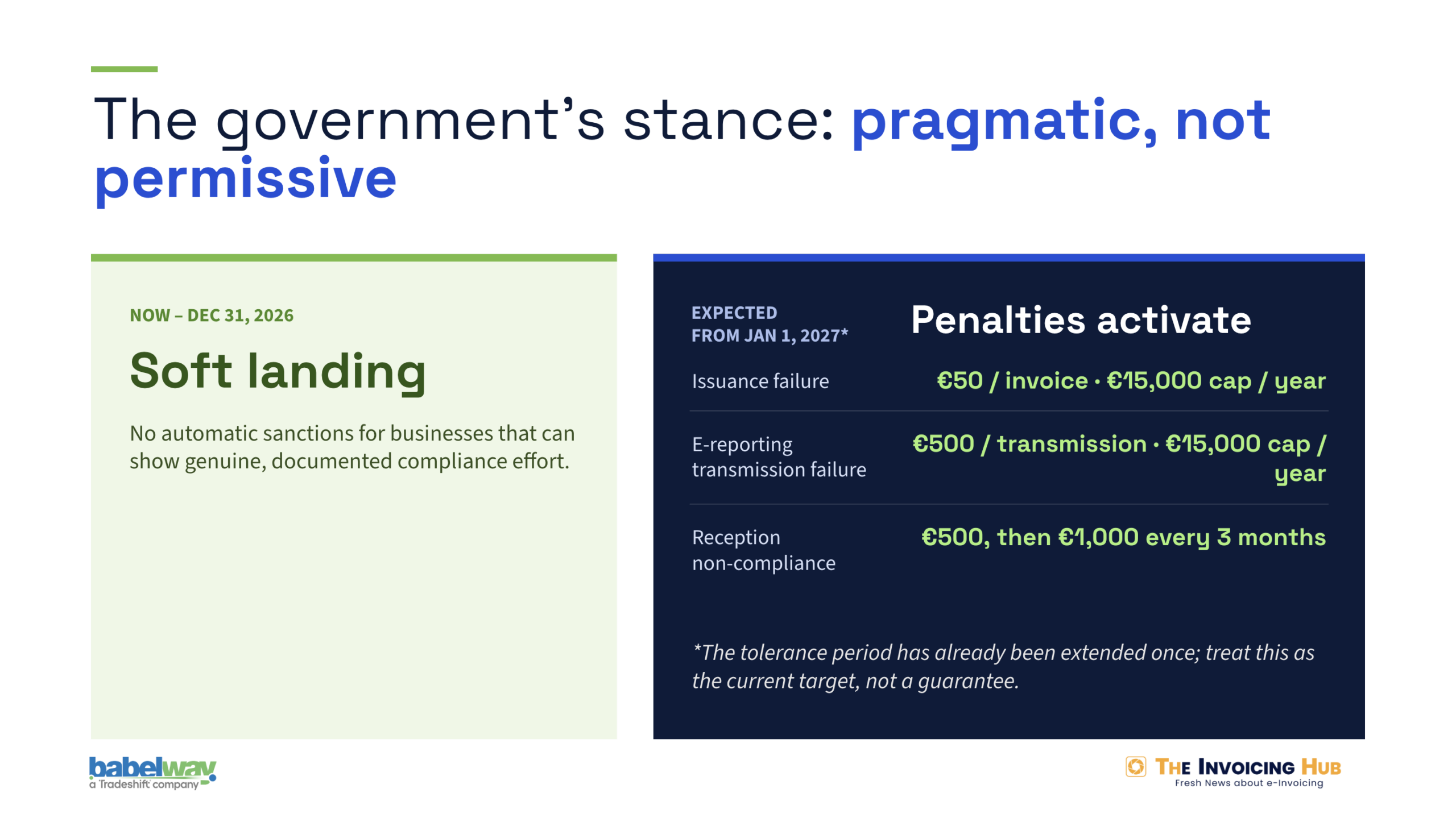
The government has opted for a soft landing. Until December 31, 2026, there are no automatic sanctions for businesses that can show genuine, documented compliance effort. From January 1, 2027, penalties are expected to apply: €50 per invoice for issuance failures and €500 per e-reporting transmission failure, each capped at €15,000 a year. The tolerance period has already been extended once, so treat that date as the current target rather than a guarantee.
What Phase 1 taught us
Michel walked through three lessons from the companies that went first. Format transformation is the hard part: native ERP output almost never matches the mandated structures, and even large enterprises with dedicated IT teams needed a transformation layer. “Registered” and “operationally proven” are different claims: only a small fraction of registered platforms were moving real volume by go-live. And testing takes longer than anyone plans for. The companies that started integration and testing early went live smoothly, and the ones that waited are still catching up.
For SMBs, the picture is different in one important way. Volumes are smaller, but so is the internal IT support. That makes a platform built for self-service more useful than one that assumes a dedicated integration team.
A roadmap from now to September 2027
A year sounds like plenty of runway. The September 2026 cohort suggests otherwise: a quarter of large billers still hadn’t picked a platform weeks before their own deadline. Here is the timeline Michel shared:
- September to December 2026: verify that your reception pipeline actually works by sending a real test document through it, confirm your annuaire registration routes to the right platform, and map what your ERP produces today against UBL, CII or Factur-X.
- January to March 2027: select your platform using proven-in-production criteria, and scope the connectivity method that fits your systems: API, SFTP, AS2 or email.
- April to June 2027: build and test. This is where large enterprises lost the most time, so budget real testing time, not a final-week check.
- July to August 2027: run a parallel pilot with a handful of real customers before switching over fully.
- September 1, 2027: go live for issuance and e-reporting.
How to choose the right Plateforme Agréée
Certification confirms that a platform cleared the DGFiP’s technical requirements. It says nothing about how deep its format coverage goes, how good its support is, or how it performs under real volume. That gap is what The Invoicing Hub’s independent benchmark of Plateformes Agréées is built to close, comparing 100 platforms on more than 60 criteria across 9 categories.
Diego closed with the four questions that separate one platform from another:
- Proven in production. How proven is it in real production environments, with real volumes across markets and use cases?
- Built for more than one mandate. Is it built for more than one mandate, so the same platform can handle e-invoicing, EDI and B2B integration as you add countries, customers and suppliers?
- Fits your systems. Will it adapt to your systems, connecting through the formats and protocols you already use (EDIFACT, X12, IDoc, XML or JSON, over API, SFTP, AS2, VAN or Peppol), or will your systems have to adapt to it?
- Clear support commitments. What happens when something goes wrong: are there clear service commitments, defined response times and high availability for business-critical flows?
Start with France, grow from there
Babelway supports businesses through the French mandate on a platform built on 18 years of B2B integration and EDI. More than 700 customers in 26 countries use it, exchanging over 650 million messages a year with 99.99% service availability. That includes long-standing e-invoicing operations in Belgium, Poland and Germany, alongside the French rollout.
For SMBs, the starting point is deliberately simple. You can start a 30-day free trial through the self-service platform, with no sales call required, connect your first channel and see real transformations the same day, with a built-in GenAI assistant to help along the way. Pricing is published and volume-based, so it’s easy to forecast. Or you can talk to our team about your 2027 roadmap and the format gap specific to your ERP. Either way, you can run Babelway alongside your current process during testing and cut over when you’re ready. And when France is covered, the same platform is there for the next country.
Watch the full webinar on demand
The recording covers all of this in more detail, including the live polls and a Q&A with Thibault, Michel and Diego on the questions SMBs are asking right now. If your deadline is September 2027, it’s a good hour to spend before the end of the year.
👉 Watch the on-demand webinar and get ahead of your 2027 deadline