Resources - Blog
Germany’s E-Invoicing Mandate: How to Go Live Before January 1, 2027 (Webinar On Demand)
By Ioana Millon (Ploesteanu)
November 17, 2026
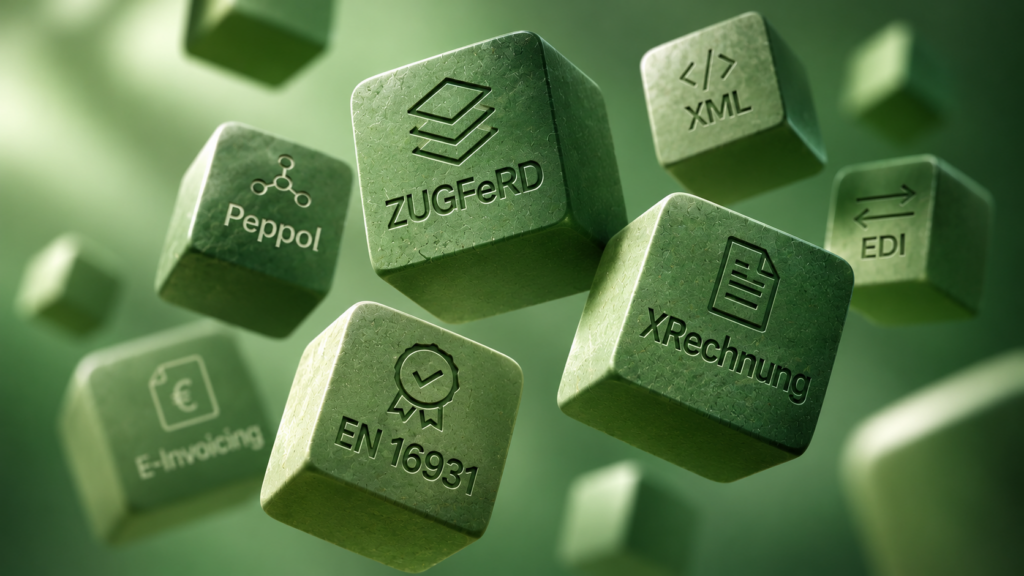
From January 1, 2027, businesses in Germany with prior-year turnover above €800,000 must issue e-invoices for domestic B2B sales. A valid e-invoice is a structured file that follows the European standard EN 16931, usually XRechnung or ZUGFeRD. A PDF sent by email no longer counts. A clear-scope project can still go live before the deadline: with Babelway, a Tradeshift company, you keep your ERP as it is, and Babelway converts its current output into compliant e-invoices in a few weeks.
That was the focus of our November 10 webinar, Get ready for the German mandate deadline: go live in 1 month with Babelway. Babelway’s Diego Mersch, Julien Gobiet and Alice Chansamone covered what changes in January, how to choose a format and channel, and a week-by-week go-live plan. The recording is now available on demand. This article summarizes the key points and answers the questions attendees asked most.
👉 Watch the webinar on demand
Key takeaways from the webinar
- Businesses with prior-year turnover above €800,000 must issue e-invoices for domestic B2B sales from January 1, 2027. All other businesses follow on January 1, 2028.
- Peppol BIS Billing, XRechnung and ZUGFeRD (version 2.0.1 or later) all count as e-invoices, as does any other format that meets EN 16931. A plain PDF does not.
- Peppol is one delivery channel, not a requirement. Email, an electronic interface or a portal download are also allowed.
- Existing EDI invoice exchange can continue until December 31, 2027. From 2028, the invoice data must be extractable in an EN 16931 format.
- With a clear scope, a go-live takes about four working weeks: scope, build, test and go live.
What changes on January 1, 2027
Germany is rolling out its B2B e-invoicing mandate in three steps. Receiving is already required, and the issuing obligation starts in 2027 for larger businesses.
| Date | Who | What applies |
|---|---|---|
| January 1, 2025 | All businesses in Germany | Must be able to receive e-invoices |
| January 1, 2027 | Businesses with prior-year turnover above €800,000 | Must issue e-invoices for domestic B2B sales |
| January 1, 2028 | All remaining businesses | Must issue e-invoices, regardless of turnover |
Until December 31, 2027, businesses at or below €800,000 can still send paper or PDF invoices (PDF only with the recipient’s consent), and existing EDI invoice exchange can continue.
Who is in scope
In scope: domestic B2B invoices between businesses established in Germany, including invoices to recipients that are small businesses or make only tax-exempt sales.
Out of scope: small-value invoices up to €250, intra-community and other cross-border supplies, and invoices to consumers (B2C). Issuers under the VAT small-business scheme do not have to issue e-invoices, but they still have to be able to receive them.
XRechnung, ZUGFeRD or Peppol BIS Billing: which format should you choose?
Choose the format your customers can process. All three below meet EN 16931. What matters is that the structured XML carries every mandatory invoice field. Where the PDF and the XML of a ZUGFeRD invoice differ, the XML prevails.
| Format | What it is | Choose it when |
|---|---|---|
| XRechnung | Pure XML in UBL or CII syntax, with no visual layer. Germany’s standard for public-sector invoicing, also used in B2B. | Your customer processes invoices automatically, or you also invoice public bodies |
| ZUGFeRD | A PDF/A-3 with the XML embedded. Version 2.0.1 or later, with the EN 16931 profile or higher. | Your customer still wants a PDF to look at, alongside the data |
| Peppol BIS Billing | UBL invoice delivered over the Peppol network | Your customer is on Peppol, or you invoice in several EU countries |
The format is only half of the decision. The law allows several channels: email, an electronic interface such as Peppol, API or SFTP, or a portal download. Pick the one your customers’ systems already use.
What the BMF letter of October 15, 2026 clarified
Germany’s Federal Ministry of Finance published new guidance about ten weeks before the 2027 deadline. The points that matter most for a go-live:
- Validation: a business-rule error does not automatically void an invoice for tax purposes. Only failed tax-relevant rules do.
- Penalties: there is no fine today for a non-compliant or paper invoice, but it can still cost your customer the input VAT deduction in an audit.
- Corrections: invoice corrections must also be issued in a structured format.
- Transition: final invoices may summarize earlier partial payments in one structured field (BT-113) until June 2030.
👉 Read our full breakdown: Germany’s new e-invoicing guidance: what the BMF clarified, and what it means for 2027.

A 1-month go-live plan, week by week
With the holiday slowdown at the end of the year, most teams have about five working weeks left before January 1. Alice Chansamone, Project Manager at Babelway, walked through the plan Babelway uses for a four-week go-live:
- Week 1, scope: list your invoice flows and top customers, confirm the format and channel each customer expects, and collect sample invoices from your ERP.
- Week 2, build: map your ERP output to XRechnung or ZUGFeRD, set up validation rules and connect your channels.
- Week 3, test: validate test invoices against EN 16931, exchange test invoices with key customers and fix mapping gaps.
- Week 4, go live: switch production flows, monitor deliveries and rejections, and fix issues within the week.
A project that starts in late November can be live by mid-December, with a week of buffer before the holidays. Starting in January means invoicing on paper or PDF while you are already out of compliance.
What to have ready on day one
- Sample invoices from each billing flow
- Your top customers and the format or channel each one expects
- How your ERP exports invoices today: file type and protocol
- Your VAT ID and the master data for the invoice header
- One owner on your side to sign off testing
- A test contact at each key customer
Example: 48 days from choosing Babelway to going live in France
A toy and games manufacturer headquartered in the UK needed its French operations to meet France’s September 1, 2026 e-invoicing mandate. Once it chose Babelway, connecting its ERP and going live took 48 days, well ahead of the deadline. The same steps apply in Germany: transform the ERP output, validate it and deliver it over the right channel.
Questions attendees asked
Most questions in the live Q&A were about formats, mappings and delivery channels. Here are the main ones, with short answers.
Our customers ask for ZUGFeRD, but we send XRechnung. Which one should we use?
Both XRechnung and ZUGFeRD (in their compliant versions and profiles) are legally recognized e-invoice formats under the German B2B mandate, as they meet the European EN 16931 standard. This means that a customer cannot reject a valid XRechnung solely because they prefer ZUGFeRD.
However, the preferred format can still be agreed upon between trading partners, particularly where contractual requirements apply. Alternative structured formats, such as EDIFACT, may also be used by mutual agreement, provided they meet the applicable legal interoperability requirements.
In practice, while XRechnung is legally valid, accommodating a customer’s preferred format can simplify integration and processing. With Babelway, you can support both formats without changing your ERP output.
Can the receiver choose the format, or must the sender support every format?
The sender is not required to support every e-invoicing format. Under German regulations, businesses must be able to receive compliant electronic invoices, including EN 16931-compliant formats such as XRechnung, ZUGFeRD and Peppol BIS billing. The receiver may express a preference for a specific format, but a compliant e-invoice does not generally require the receiver’s consent. However, existing contractual agreements should still be respected.
With Babelway, businesses can easily convert their invoice data into different formats to accommodate customer preferences without modifying their ERP.
Do we need Peppol to comply in Germany?
No. Peppol is one allowed channel, alongside email, other electronic interfaces and portal downloads. Peppol BIS Billing is an EN 16931 format, so it can be used when buyer and seller agree on it. Babelway has been a certified Peppol Access Point since 2014, if your customers do use Peppol.
Are the mappings standard, or do we build them ourselves?
Both options exist with Babelway. Babelway maps your ERP data, checks it against EN 16931 and XRechnung rules and converts it into XRechnung, ZUGFeRD or Peppol UBL. You can build and adjust mappings yourself with drag-and-drop tools in the browser, or have Babelway’s team set them up for you.
Can our existing EDI invoice exchange continue after 2027?
Yes. EDI is not disappearing under Germany’s e-invoicing mandate.
Until December 31, 2027, existing EDI invoice exchanges can continue under the transitional rules, even if they do not yet meet EN 16931 requirements, provided the recipient agrees.
From January 1, 2028, EDI formats such as EDIFACT will remain permitted, provided the legally required invoice information can be correctly and completely extracted into a format that complies with or is interoperable with EN 16931. With Babelway, businesses can preserve their existing EDI integrations and adapt their invoice flows to meet the new requirements, without necessarily rebuilding their entire EDI infrastructure.
Is there a fine for missing the January 2027 deadline?
No specific administrative fine currently applies under Germany’s VAT legislation solely for issuing a paper or non-compliant invoice when an e-invoice is required, as clarified by the BMF in its letter of October 15, 2026.
However, this does not remove the legal obligation to issue compliant e-invoices. Non-compliant invoices may create tax audit complications, delay payments and potentially affect the customer’s ability to deduct input VAT. Even without a specific fine, businesses should prepare to issue compliant e-invoices to avoid operational and tax-related complications.
How Babelway helps you go live fast
Babelway is built for fast, low-complexity projects: a clear scope, a fixed deadline and a need to be compliant without a large implementation project.
- Fast: a project with a clear scope goes live in weeks.
- Self-service: set up and run your flows yourself in the browser, starting with a 30-day free trial and no sales call.
- Your ERP as it is: Babelway converts what your ERP already exports (XML, EDIFACT, IDoc, CSV, JSON or PDF) into XRechnung, ZUGFeRD or Peppol UBL, and delivers it over email, Peppol, API, SFTP or AS2.
- EDI and e-invoicing on one platform: the same setup also handles your other EDI flows with trading partners.
Babelway has 18 years of experience in B2B integration and EDI, with more than 700 customers in 26 countries, over 650 million messages exchanged a year and 99.99% service availability.
Watch the webinar on demand
The full recording covers the mandate timeline, the BMF guidance, format and channel choices, the week-by-week plan and the live Q&A.
Speakers:
- Diego Mersch, Senior Inside Account Executive, Babelway
- Julien Gobiet, Principal Project Manager, Babelway
- Alice Chansamone, Project Manager, Babelway
👉 Watch the webinar on demand
Ready to start? Start a free 30-day trial and connect your first channel the same day, or talk to our team about your go-live plan before January 1.
This article summarizes the German e-invoicing rules and the BMF letter of October 15, 2026 for general information and is not tax advice. Check the official guidance and speak with your tax advisor before changing your invoicing process.