
Resources - Blog
Poland’s KSeF e-invoicing mandate: A technical integration guide for IT and EDI teams
By Ioana Millon (Ploesteanu)
April 14, 2026
Read time:7 MINUTES
Poland’s mandatory B2B e-invoicing is now live for all VAT-registered businesses. Here is what IT and EDI specialists need to know about the FA(3) schema, KSeF 2.0 API, VAT reporting changes, and how Babelway fits into your integration stack.
Poland’s KSeF mandate is live. On August 27, 2025, Poland’s President signed into law the amendment to the Value-Added Tax Act, officially establishing the Krajowy System e-Faktur (KSeF) as the mandatory national e-invoicing system. Large companies with annual turnover exceeding PLN 200 million have been under the obligation since February 1, 2026.
As of April 1, 2026, the mandate now applies to all other VAT-registered businesses operating in Poland. If your systems are not integrated with KSeF, invoices issued outside the platform are no longer legally valid for B2B transactions. This article cuts straight to the technical requirements your integration team needs to address.
👉 Try before you buy. Babelway is available for free for 30 days.
What is the current status of the KSeF mandate?
The rollout is complete for the vast majority of businesses and follows a phased schedule based on company size:
February 1, 2026: Mandatory for large taxpayers with annual turnover exceeding PLN 200 million. All businesses regardless of size must be ready to receive invoices via KSeF from this date.
April 1, 2026: Mandatory for all other VAT-registered businesses, including foreign VAT-registered companies without a fixed establishment.
January 1, 2027: Mandatory for micro-taxpayers with monthly sales invoicing not exceeding PLN 10,000.
One important note on enforcement: no penalties will be imposed for errors in KSeF usage throughout 2026, giving businesses a one-year grace period to stabilise their processes. However, from 2027, non-compliance such as issuing invoices outside KSeF will result in financial penalties, rejected invoices, and blocked VAT deductions, enforced by the Polish Tax Authority (KAS).
The core technical requirements
The FA(3) schema
The invoice format has changed. On May 8, 2025, the Ministry of Finance published the FA(3) schema, which officially replaces the FA(2) schema as of January 2026. The new schema introduces new mandatory and optional fields, strengthens validation controls, improves the consistency of tax and accounting data, and incorporates adjustments derived from public consultation and experience during the voluntary period.
KSeF only supports structured data within the FA(3) schema. PDF attachments, Word documents, and unstructured formats are not accepted as legal invoices. Your ERP or middleware must be able to generate and parse FA(3)-compliant XML.
KSeF 2.0 API
In June 2025, Poland finalized its KSeF 2.0 specs and the FA(3) structured invoice schema. The Ministry of Finance released official documentation and integration tools, and sandbox testing opened September 30, 2025, allowing companies to simulate KSeF and Peppol submissions.
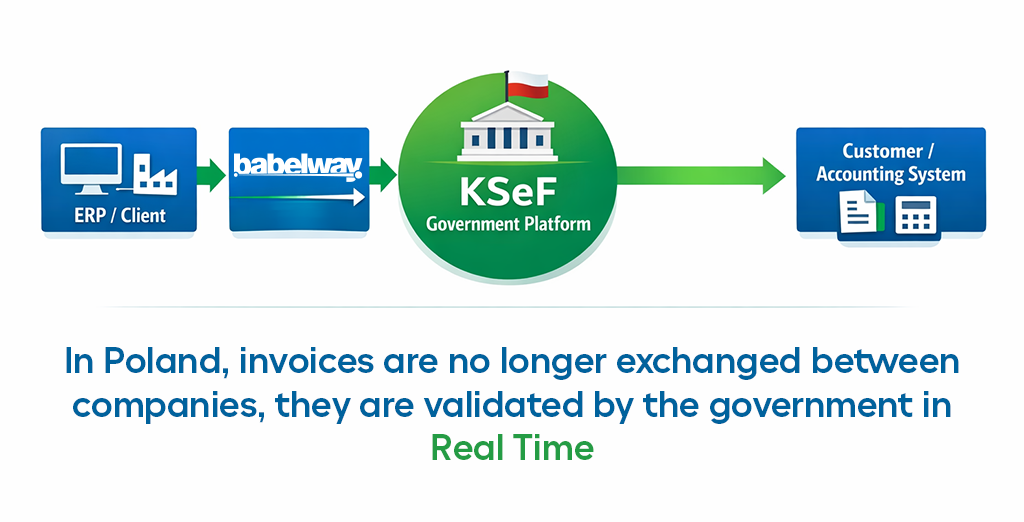
Your integration layer needs to connect to the KSeF 2.0 API for real-time invoice submission, retrieval, and status handling. Each invoice submitted through KSeF receives a unique KSeF identification number that must be stored and referenced in subsequent VAT reporting.
Authentication and access management
To issue invoices via KSeF, businesses must file the ZAW-FA form for entities other than natural persons to authorise people or entities to issue invoices. Authentication methods include qualified electronic seals, tokens available until end of 2026, and KSeF certificates. Your system architecture needs to account for certificate management and delegation governance as part of your integration setup.
Offline and contingency modes
Voluntary use of offline mode is permitted until December 31, 2026. This mechanism allows invoices to be issued outside the system in specific situations, with subsequent submission to KSeF. An offline24 concept is also introduced, which allows an invoice to be sent the next day in certain technical cases. Invoices issued in offline or emergency modes must include a QR code for verification. Your integration needs to handle these contingency flows, not just the standard API path.
Who is in scope and what is excluded?
The mandate covers all taxable persons who are required to issue invoices under Polish VAT law, regardless of size or location, including foreign businesses with a Polish VAT number. Domestic B2B and B2G transactions are both mandated. Cross-border intra-EU B2B transactions are also mandatory, meaning Polish sellers must issue invoices via KSeF even if a copy is sent to a foreign buyer.
Notable exclusions to factor into your routing logic: specific transactions exempt from the structured e-invoicing mandate include highway tolls, passenger transportation tickets for train, bus, and air travel, and certain financial or insurance services.
B2C transactions remain optional under KSeF. Businesses can continue issuing traditional receipts or paper and PDF invoices for consumer transactions.
Your KSeF integration checklist
Here is what IT and EDI teams need to work through to achieve full KSeF compliance:
1. FA(3) schema mapping:
Map your internal invoice data model to the FA(3) XML schema. Validate against the official schema published by the Ministry of Finance. Any fields that were present in FA(2) but changed or removed in FA(3) need to be identified and updated in your system.
2. KSeF 2.0 API integration:
Build or configure your integration to the KSeF 2.0 API. This covers invoice submission, receipt, status retrieval, and error handling. Test thoroughly in the sandbox environment before connecting to production.
3. Authentication setup:
Register your ZAW-FA authorization, configure your qualified electronic seal or KSeF certificate, and set up delegation rules for any third-party service providers handling invoicing on your behalf.
4. Offline and contingency handling:
Implement the offline24 flow for submitting invoices when KSeF is temporarily unavailable. Ensure QR code generation is supported for invoices issued outside the platform.
6. Peppol interoperability:
Poland has confirmed that Peppol will complement KSeF for smoother EU interoperability. Tradeshift If your organization exchanges invoices cross-border within the EU via Peppol, you need to ensure your setup handles both the KSeF submission path for Polish domestic transactions and Peppol routing for cross-border flows.
How Babelway handles KSeF integration
Poland’s KSeF mandate requires structured XML in a specific schema, real-time API connectivity, contingency mode handling, and synchronized VAT reporting updates, all at once. Babelway is built to handle exactly this kind of multi-layer integration.
FA(3) XML transformation:
Babelway’s format transformation engine handles XML natively, meaning it can map your ERP’s internal invoice structure, whether that is IDocs, EDIFACT, UBL, or a proprietary XML, directly to the FA(3) schema that KSeF requires. No custom development is needed on your ERP side.
KSeF 2.0 API connectivity:
Babelway connects to external APIs and supports the protocols required for KSeF submission and retrieval. You configure the integration once, monitor it centrally, and Babelway handles message routing, error handling, and delivery confirmation.
Full control for your team:
Babelway is a self-service integration platform designed for IT and EDI specialists. You build, test, monitor, and modify your KSeF flows directly, with full visibility into message transformation and delivery status, without depending on a vendor support ticket for every change.
Is your integration stack ready for KSeF?
The mandate is live. The February 2026 deadline for large companies has passed, and as of April 1, 2026, all VAT-registered businesses in Poland are under the obligation. The 2026 grace period on penalties gives teams breathing room to stabilise their integration, but it will not last. From 2027, non-compliance will trigger financial penalties, rejected invoices, and blocked VAT deductions.
Babelway is ready to connect your systems to KSeF. As an EDI and e-invoicing integration platform supporting FA(3) XML, KSeF 2.0 API connectivity, and multi-country mandate coverage, Babelway gives your IT team the tools to implement Poland compliance efficiently and to manage every other mandate that follows.